
Welding Fume Exposure Limit Slashed: Impacts and Compliance Challenges
Introduction: A New Standard for Welding Fumes
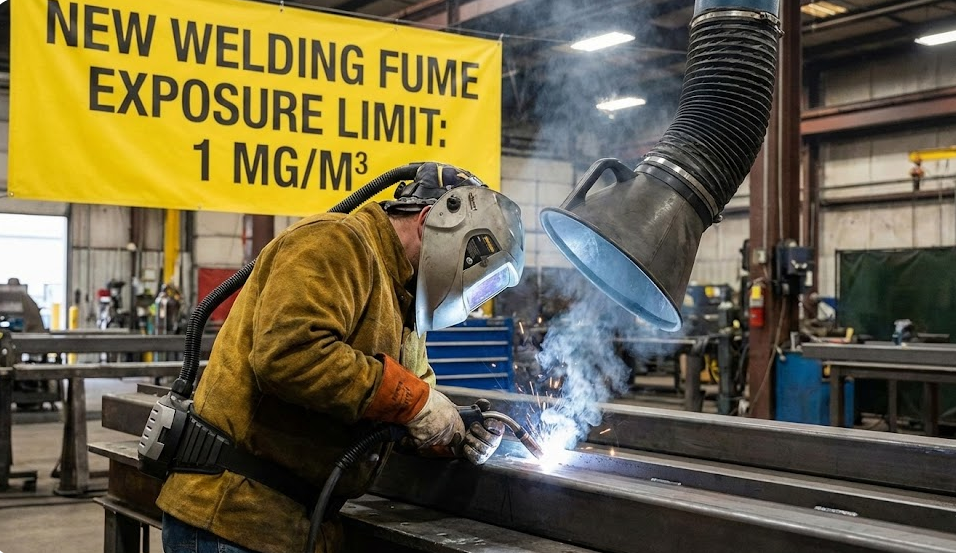
Australia has dramatically tightened its allowable limit for welding fume exposure. As of 2024, the workplace exposure standard (WES) for welding fumes has been cut from 5 mg/m³ to 1 mg/m³ over an 8-hour shift. This five-fold reduction aligns Australia’s limits with the most stringent international standards – equivalent to the American Conference of Governmental Industrial Hygienists (ACGIH) guideline and New Zealand’s limit of 1 mg/m³. Work health and safety ministers approved the change to better protect workers from serious health effects. The new 1 mg/m³ threshold is now enshrined as a Workplace Exposure Limit (WEL) – a term replacing the old “standard” to emphasise it is an absolute maximum that must not be exceeded. This shift in terminology underscores that regulators expect employers to treat 1 mg/m³ as a hard legal limit, not a mere guideline. In practical terms, every employer (or Person Conducting a Business or Undertaking, PCBU) must ensure welding fume concentrations remain below 1 mg/m³, and keep hazardous constituents of the fume below their individual limits as well.
Why the Exposure Limit Changed
The tightening of the fume limit reflects mounting evidence of health risks from welding. Welding fumes are a complex mix of very fine metal oxide particles and gases produced when metal is heated above its boiling point. Most fume particles are ultrafine (smaller than 0.1 µm), meaning they can penetrate deep into the lungs. Research has linked prolonged welding fume exposure to lung damage, various respiratory illnesses, and several forms of cancer. In 2017, the International Agency for Research on Cancer (IARC) formally classified welding fumes as “carcinogenic to humans” (Group 1) based on substantial evidence of elevated lung cancer rates in welders. This was a significant upgrade from its previous “possibly carcinogenic” classification and put welding fume in the same risk category as asbestos and tobacco smoke. Safe Work Australia explicitly notes that reducing the fume WES to 1 mg/m³ will “better protect workers from the adverse health effects associated with welding fumes, such as lung cancer and other lung diseases.”
It’s not just chronic cancer risks that drove the change – acute effects play a role too. Inhaling welding fumes, even briefly, can irritate the respiratory tract, causing symptoms such as throat dryness, coughing, and a tight chest. Many welders experience “metal fume fever,” a flu-like illness, after intense exposure, especially to zinc or iron fumes. More alarmingly, the UK’s Health and Safety Executive estimate that breathing metal fumes leads to 40–50 welders being hospitalised each year (typically with severe lung infections like pneumonia). Tragically, around two welders per year in the UK die of pneumonia linked to fume exposure. These acute cases underscore that welding fumes are far from harmless in the short term, and they strengthen the case for more stringent controls. By adopting a 1 mg/m³ limit (and even lower limits for specific metals, discussed below), Australian regulators aim to reduce both the immediate and long-term health toll of welding fumes.
Another reason for the revised limit is the lack of a clear “safe” exposure level in scientific literature. Safe Work Australia’s review found insufficient data to set a health-based threshold for total welding fumes. In fact, some countries have eliminated general exposure standards for “not otherwise classified” welding fume, opting instead to regulate only the individual chemical constituents. The logic is that if each toxic ingredient (like manganese, chromium, etc.) stays below its own limit, then total fume should be adequately controlled. However, the counterargument – and the view implicit in Australia’s decision – is that total fume concentration matters because it correlates with risk (this is supported by IARC’s cancer finding based on total fume). Thus, Australia chose to re-establish a stringent overall fume limit and tighten specific component limits. In summary, the move to 1 mg/m³ aligns Australia with global best practice and reflects an abundance of caution in protecting welders’ health.
Historical Welding Fume Levels vs. the New Limit
One immediate challenge of the new 1 mg/m³ limit is clear: historically, most welding jobs have been generating fume concentrations well above 1 mg/m³. A comprehensive analysis of over 10,000 welding fume measurements (spanning from the 1980s up to 2024) reveals that the vast majority would fail the new standard. These samples were predominantly collected in mining and manufacturing settings (over 99% from open-air or surface worksites, with very few from enclosed underground locations). In other words, almost all past welding fume exposures that were previously considered “acceptable” under the old 5 mg/m³ standard are now non-compliant under the 1 mg/m³ limit. This indicates a significant gap between historical exposure levels and the new safety benchmark.
Focusing on recent years illustrates the compliance gap. Between 2018 and 2024 – a period when awareness of welding fume hazards was growing – only about 29% of sampled welding jobs would meet the new 1 mg/m³ limit. Put differently, more than two-thirds of recent welding fume measurements across industries exceeded the new exposure ceiling. Many of these jobs produced fume levels in the 1–5 mg/m³ range, which was formerly acceptable but is now out of bounds. Figure 1 from the original analysis showed mean fume concentrations over time, which generally hovered around a few milligrams per cubic meter. There was no clear downward trend in the past decade – average fume levels did not significantly improve from 2015 to 2024. This suggests that, before the regulatory change, industry efforts were not achieving substantial overall reductions in welding fume generation or exposure.
Different industry sectors show varying degrees of compliance and risk. The mining sector, in particular, has some of the highest levels of welding fume exposure. In the dataset, the iron ore mining industry had the highest average fume concentration – around 2.7 mg/m³. This means it is almost three times the new limit, underscoring how far typical conditions in that sector are from the new compliance target. Other mining commodities, such as gold and base metals, also had high fume levels, whereas the nickel mining sector showed comparatively lower fume concentrations. In fact, in 2023, the nickel sector was the only one reporting an average welding fume level below 1 mg/m³. This implies that some industrial sub-sectors have begun adapting practices (or inherently have less fume-intensive processes), but many others remain well above the new limit. Outside of mining, sectors such as heavy fabrication, shipbuilding, and construction are also expected to face challenges, as they often involve welding in confined or high-fume environments (though detailed data for those were not provided in the analysis, anecdotal evidence and smaller studies point to frequent exceedances).
One important nuance is that even “total” fume measurements under 1 mg/m³ can mask hazards. Welding fumes contain hazardous constituents, notably manganese, hexavalent chromium, nickel, and iron oxide, among others – each with its own exposure limit (often much lower than 1 mg/m³). In a stratified subset of 6,619 samples from the study, about one-third (32.6%) were below 1 mg/m³, indicating compliance with the new general fume WEL. However, analysis of those “compliant” samples found that 9 of them still exceeded the limits for individual toxic metals, such as manganese, vanadium, iron oxide, or chromium. In other words, a welder could be under the total fume limit but still breathe unhealthy levels of specific metals. This finding validates the authorities' and experts' insistence that companies must monitor both total fumes and their key components. The Australian Institute of Occupational Hygienists (AIOH) has stressed that keeping total welding fume below 1 mg/m³ is advisable. Still, it is insufficient if any constituent exceeds its own safe threshold. For example, a stainless-steel welding task might easily stay under 1 mg/m³ total fume yet still exceed the very low WES for hexavalent chromium (0.05 mg/m³) or nickel (0.1 mg/m³), both of which are carcinogens. The key takeaway for industry is that compliance requires a granular understanding of fume composition, not just keeping the dust down in general.
New Exposure Limits for Toxic Fume Components
Concurrent with lowering the overall fume limit, Australian regulators announced sharply reduced WELs for several hazardous substances commonly found in welding fumes. These changes, slated to take effect nationwide by 2026, target specific metals and gases known to pose high health risks. For instance, the allowable concentration of manganese in welding fume (inhalable fraction) will drop from 1 mg/m³ to 0.1 mg/m³, a tenfold tightening. Manganese is a prevalent component of steel welding fumes, and excessive exposure can cause neurological damage; the new respirable manganese limit is even lower (0.02 mg/m³, down from 1 mg/m³), reflecting its greater potency when particles reach deep lung tissue. Another significant change is for cadmium oxide, a highly toxic fume constituent especially in some brazing and specialised welding: its 8-hr limit (TWA) will go from 0.01 mg/m³ to 0.001 mg/m³. This 90% reduction makes the cadmium fume limit extremely low, effectively forcing any cadmium-containing welding process to either generate near-zero fumes or implement rigorous controls. The beryllium fume limit, already very low, will tighten by two orders of magnitude – from 0.002 mg/m³ to 0.00002 mg/m³. Beryllium is a rare component in welding (found in some copper alloys), but where present, it is a potent carcinogen, hence the essentially “zero” tolerance now. Other substances, such as lead, fluorides, and iron oxide, showed minor or no changes in their limits (since some were already relatively low). Still, overall, the trend is a sweeping increase in stringency for known toxic agents in welding fumes.
It’s worth noting that these component-specific limits bring Australia into line with or beyond international best practices. The new inhalable manganese limit of 0.1 mg/m³ matches the strict limit adopted in some European countries and is closer to ACGIH’s recommended 0.02 mg/m³ for respirable manganese. Lowering cadmium and beryllium limits aligns with long-standing guidance from bodies like ACGIH. It reflects that even trace exposures to these metals can be dangerous (beryllium, for example, causes chronic lung disease and cancer at extremely low concentrations). The inclusion of a separate limit for the respirable vs. inhalable fractions of welding fume (for substances like manganese and molybdenum) also indicates a more nuanced approach in the regulations – finer particles are more harmful and now have stricter caps. For PCBUs, this implies that air monitoring programs must be robust and capable of detecting very low concentrations of these metals. Standard gravimetric sampling for total particulate may not suffice; more sensitive analytical methods (e.g., filter analysis by ICP-MS for metals) may be required to verify compliance with parts-per-billion-level limits, such as 0.00002 mg/m³ for beryllium. Regulators have provided updated documentation (the revised WES/WEL list and guidance materials) listing all these new limits. It will be crucial for safety professionals to review these details so they understand which processes might be affected. For example, aluminium welding fume now also has a 1 mg/m³ limit (down from 5), so high-production aluminium welders will need similar controls to those used by steel welders. In summary, the regulatory net is tightening not just on “welding fume NOC,” but on the individual hazards within the fume – effectively raising the bar for what constitutes a safe welding environment.
Historical Compliance (Summary of Findings)
Compliance with the new 1 mg/m³ limit has been historically low. One of the studies conducted by the Australian regulator, Analysing 10,496 welding fume measurements (1986–2024), found the vast majority exceeded 1 mg/m³, indicating that past control measures were generally inadequate by today’s standards. Even in 2018–2024, less than one-third of samples were under 1 mg/m³. The mining sector showed particularly high exposures – e.g. iron ore mining jobs averaged ~2.7 mg/m³, nearly triple the new limit. Only the nickel mining sector managed to attain an average below 1 mg/m³ by 2023. Other industries (manufacturing, construction, etc.) were not analysed in detail in the provided data, but are also expected to have many scenarios above the new limit (especially without local exhaust ventilation). Significantly, some samples with total fume levels below 1 mg/m³ still exceeded acceptable levels of toxic metals such as manganese and chromium, underscoring the need to monitor individual fume constituents.
Changes in Exposure Limits: In tandem with reducing the total fume WES to 1 mg/m³, authorities introduced a host of stricter WELs for specific fume components (to be implemented by 2026). For example, manganese fume limits were cut from 1 mg/m³ to 0.1 mg/m³ (inhalable) and 0.02 mg/m³ (respirable), cadmium oxide from 0.01 to 0.001 mg/m³, and beryllium from 0.002 to 0.00002 mg/m³. These represent 10× to 100× tighter limits, reflecting the extreme toxicity of these metals. Other components, such as nickel (now 0.1 mg/m³), aluminium (1 mg/m³), and others, were also adjusted. The term “Workplace Exposure Standard” is being replaced by “Workplace Exposure Limit” to emphasise that these values are mandatory ceilings that must not be exceeded. The new limits align with international benchmarks and ACGIH recommendations, aiming to drive industries toward better fume-control technologies.
Implications for Industry: Achieving Compliance

Illustration: A welder uses local exhaust ventilation to capture fumes at the source. Strong engineering controls, such as on-torch fume extractors, can significantly reduce airborne welding fume concentrations.
For industries that involve welding, the message is clear – business as usual will not suffice under the new exposure regime. Employers must take proactive steps immediately to bridge the gap between historical fume levels and the new 1 mg/m³ limit. The priority is comprehensive exposure monitoring. Companies should review existing welding processes and conduct air monitoring to identify where and when fume levels exceed the limit. This includes measuring total welding fume in workers’ breathing zones and, critically, analysing the concentrations of key hazardous fume constituents (e.g., iron, manganese, chromium, nickel). Modern direct-reading instruments and traditional gravimetric sampling with subsequent lab analysis can both play a role. Monitoring should be done under representative worst-case conditions – for instance, during high-production welding or in confined spaces – to ensure that even peak exposures are assessed. If firms are unsure whether specific short-duration jobs or intermittent tasks might exceed limits, they are obliged to conduct monitoring to determine. In addition to personal monitoring, some companies are deploying fixed-point aerosol sensors around welding bays to track fume levels and trigger alarms if ventilation falters continuously.
Upgrading engineering controls is the cornerstone of meeting the new standards. The hierarchy of power in occupational hygiene prioritises elimination or engineering solutions over personal protective equipment, for good reason: they address the hazard at the source. To comply with a 1 mg/m³ limit, many workplaces will need to invest in more effective fume extraction systems. When positioned correctly near the weld, traditional local exhaust ventilation (LEV) hoods can capture a substantial portion of the fume. However, studies have found that on-gun fume extraction (LEV built into the welding torch) is even more effective, as it continuously suctions fumes right as they form at the arc. In one industry comparison, on-gun extraction reduced fume concentrations significantly more than a movable LEV hood did. Specifically, for standard processes such as flux-cored arc welding (FCAW) and MIG welding, on-torch extraction reduces welder fume exposure by a factor of 12 on average (compared to no control), compared to roughly a 9-fold reduction with a standard extraction hood. The practical implication is that up-to-date fume extraction technology can often achieve an over 90% reduction in inhaled fumes when used appropriately. Employers should evaluate whether investing in on-gun extraction torches, adjustable high-flow fume arms, or downdraft tables for welding operations could bring welding operations into compliance with applicable exposure limits. Additionally, simple measures such as positioning portable fans or local exhaust units to create airflow away from the welder’s breathing zone can help. However, care must be taken not to disperse fumes only to other workers.
Ventilation upgrades may need to be complemented by process changes. Whenever feasible, higher-fume welding methods (such as flux-cored wire or stick welding) should be replaced with cleaner processes (like TIG or MIG with solid wire) that generate less fume. Using welding rods or wires with lower fume-generating coatings (e.g., low-manganese filler materials) is another substitution that can reduce exposure at the source. Automation and robotics can, in some cases, eliminate exposure to fumes, though that’s a longer-term investment. In short, removing or reducing the fume before it enters the air is the most reliable way to comply.
Despite best efforts with engineering controls, some fume generation is inevitable in welding.
Administrative controls can help minimise workers’ time in fume-intensive conditions. Strategies include rotating welders so that no individual spends too many hours on high-fume jobs, scheduling hot jobs when fewer workers are around (to limit the number exposed), and isolating welding areas from other work zones. Ensuring adequate general workshop ventilation (such as roof exhaust fans or open bay doors) can prevent fume buildup in the broader region. Employers should also enforce work practices such as positioning oneself upwind of the weld and taking fume breaks – simple behavioural adjustments that can reduce inhalation.
Finally, respiratory protective equipment (RPE) serves as the last line of defence. Under the new regulations, it’s clear that RPE should not be the primary control – companies are expected to implement all “reasonably practicable” higher-order controls first. However, the appropriate use of RPE will be essential to compliance, especially during transitions or for tasks where fumes cannot be sufficiently engineered out. Powered Air-Purifying Respirators (PAPRs) with high-efficiency particulate filters (P3) are commonly used by welders and can significantly reduce inhalation of fumes when worn. Research has shown that a high-quality welding PAPR (with a helmet and filter blower unit) can provide an effective protection factor well above 50, meaning the air inside the helmet has <2% of the fume concentration outside. In fact, one study recorded protection factors in the 1000s for certain welding conditions with a PAPR. While this is reassuring, RPE works only if it is implemented meticulously: employers must ensure welders are fit-tested (for tight-fitting respirators), adequately trained, and consistently wear the equipment whenever needed. Regular maintenance of respirators (battery charging, filter replacement, and cleaning) is also critical to retain their efficiency. The new exposure limit essentially requires that, if any welding task cannot be kept below 1 mg/m³ by ventilation alone, welders must wear effective respirators as a supplement, and that this requirement be baked into standard operating procedures.
Cultural Shift
All these measures require a cultural shift as well. Worker engagement and training are key. Welders and their supervisors should be educated about the risks of welding fumes and the importance of the new limits – not merely as a compliance issue, but as a matter of personal health. Explaining that welding fume has been definitively linked to lung cancer and severe lung disease can help motivate adherence to controls. Involving workers in choosing and testing control solutions (for example, getting feedback on the comfort of a new fume extractor or PAPR helmet) can improve uptake. As Safe Work Australia suggests, PCBUs should “talk to your workers and HSRs about the reduced WES, how it might impact your workplace, [and] changes to control measures and any training needed.” This kind of consultation not only supports compliance but also fosters a safety-first mindset among the welding crew.
Importantly, early adopters have shown it’s possible to achieve significant reductions. In one case study, a large mining company in South Australia implemented enhanced ventilation and dust extraction systems for a high-fume welding task. The result was a 50% reduction in welding fume concentrations for those workers. This was achieved through risk assessment, collaborative problem-solving between engineers and hygienists, and diligent testing of controls. Such success stories demonstrate that with the right investments and commitment, even the most demanding welding jobs can be made much safer. Companies across manufacturing, mining, construction, and other sectors should examine these examples and consider similar initiatives. The bottom line for industry is that significant improvements in fume control are both necessary and achievable, and the new legal limits leave no alternative but to act.
Implications for Regulators and Enforcement
From the regulator’s perspective, the shift to a 1 mg/m³ fume limit and the new WEL framework will require concerted efforts to ensure compliance across diverse workplaces. Regulators (state WorkSafe agencies and Safe Work Australia at the policy level) recognise that many businesses, especially smaller fabricators and contractors, will need guidance and support to meet the new requirements. One immediate implication is the development of explicit guidance materials and compliance tools. Safe Work Australia has updated its official guidance, including the release of an information sheet on welding fumes and the revision of the Model Code of Practice for welding processes. These resources outline steps for PCBUs, including identifying fume hazards, conducting air monitoring, and selecting appropriate controls. Regulators should ensure that this guidance is widely disseminated and easily understood by businesses of all sizes. This might involve industry-specific guidelines (for example, separate advice tailored to a small automotive repair shop versus a large mining company) and practical checklists or toolkits that workplaces can use to assess themselves.
Training and outreach will be another focus. Work safety authorities may ramp up awareness campaigns – similar to the “Clean Air. Clear Lungs.” initiative – emphasising the health risks of welding fumes and the new legal obligations. They will likely engage industry associations (such as welding trade groups, metal fabricators' alliances, etc.) to spread the word. Regulators must communicate that exposure limits are a last line of defence, as one WorkSafe bulletin put it, the WEL is a “statutory maximum upper limit” and not a guarantee of safety. Employers should be aiming for as low as reasonably practicable, well below the limit in many cases, to truly protect health. This philosophy may need reinforcing through education, since some workplaces historically treated the old 5 mg/m³ standard as an acceptable level to work right up to.
To encourage compliance, regulators might also consider incentives and support. For example, subsidies or grants for small businesses to purchase fume extraction equipment could be hugely beneficial. Funding research or pilot programs on innovative fume control technologies (such as new ventilation designs or cleaner welding methods) can also pay off in the long run. In some jurisdictions, regulators have partnered with academic institutions or industry bodies to test practical solutions – continuing and expanding these collaborations will help keep guidance up to date with technological advances.
Of course, enforcement is the other side of the coin. Once sufficient lead time has passed and resources have been provided, regulators will expect compliance and will likely step up inspections of welding activities. We can anticipate more frequent hygiene spot-checks at worksites where welding is routine. Inspectors may ask to see welding fume monitoring records, ventilation system maintenance logs, and evidence of worker training on fume risks. If a workplace cannot demonstrate efforts to measure and control welding fumes, it could face penalties under the law. Particularly in high-risk environments (such as enclosed-space welding or high-fume processes), inspectors may carry direct-reading instruments to verify fume levels. Non-compliance with the 1 mg/m³ WEL (mainly if significant overexposure is found) would likely result in improvement notices or even stop-work orders until controls are improved. The regulators’ challenge is to apply enforcement consistently across industries. They are working through national policy groups to harmonise the implementation of the new WEL across the states and territories to avoid loopholes or confusion. By December 2026, the WELs for all substances are expected to be legally in force everywhere, meaning regulators will uniformly hold businesses accountable to the new limits.
Another implication is the need for ongoing data collection and review. Regulators will be keen to see if the lower limits actually lead to lower exposures in practice. This could involve requiring industries (especially mining, as is already done in Queensland) to report periodically on welding fume monitoring results so that trends can be tracked. If specific sectors continue to struggle, additional targeted interventions might be crafted. Conversely, if new scientific evidence emerges or control technologies improve dramatically, Safe Work Australia has committed to periodically revisiting the WELs to ensure they reflect best practice. Welding fume composition is also evolving with new materials and techniques, so regulators will stay alert to any emerging hazards (for example, nanoparticle emissions or new alloy additives) that might warrant further action.
In summary, regulators have a dual role: facilitator and enforcer. They must facilitate compliance by educating the industry and equipping it with know-how to meet the new standards. At the same time, they must be prepared to take firm enforcement measures against those who fail to meet the safety requirements. The success of the latest welding fume limits will hinge on this balanced approach. By working collaboratively with companies and workers – offering support while maintaining oversight – regulators aim to ensure that the ambitious goal of the new 1 mg/m³ limit translates into real, measurable reductions in welders’ exposure nationwide.
Conclusion
Reducing the welding fume exposure limit to 1 mg/m³ represents a watershed moment in occupational health for welders and those who work around them. It brings Australia to the forefront of worker protection, aligning with global standards and acknowledging the serious carcinogenic risks posed by welding fumes. However, it also confronts industries with a stark reality: past practices have left most workplaces far above this new benchmark, and a concerted effort is required to close that gap. The evidence from decades of exposure data makes it clear that simply doing what we’ve always done will lead to widespread noncompliance. Instead, a paradigm shift is needed – one that sees welding fume exposure control as fundamental as wearing a seatbelt in a car or a hard hat on a construction site.
The analysis indicates that existing control measures have been largely insufficient to meet the updated standard. High fume levels, especially in sectors like mining and heavy manufacturing, pose significant health risks under the new criteria. Nonetheless, the situation is far from hopeless. The technology and knowledge to drastically reduce welding fume exposure already exist, and there are examples of organisations that have successfully applied them (cutting fume levels by half or better). By investing in engineering controls such as advanced local exhaust ventilation – particularly at-source extraction, and by rigorously enforcing their use, companies can make considerable strides in protection. In tandem, a strong culture of safety must encourage continuous monitoring and equipment maintenance, and empower workers to speak up about fume hazards.
For workers, the changes mean a safer future, hopefully with fewer cases of “welder’s lung,” metal fume fever, or welding-related cancers in the years to come. But it also means adjustments in how work is done: wearing slightly bulkier helmets with respirators, taking a few extra minutes to position the fume extractor, or spending time in training sessions to learn new practices. These are small trade-offs for the reward of long-term health and the ability to enjoy a whole career without debilitating illness. As one welding safety slogan puts it: “Clear lungs, bright future.” Achieving that bright future will require the commitment of everyone involved – welders, supervisors, engineers, safety officers, and regulators – working together to ensure that the air workers breathe on the job is as clean as possible.
The reduction in the exposure limit also carries implications beyond welding. It sends a signal to all industries that occupational exposure standards are not static and will be tightened when evidence warrants. Similar evaluations are underway for other airborne contaminants. Industries and regulators should apply the lessons learned here: robust data collection, stakeholder consultation, and readiness to act decisively in the face of health risks. In the case of welding fumes, the path forward is clearly mapped. By following that path, through better controls, continuous improvement, and vigorous enforcement, Australia can significantly reduce the toll of occupational lung disease and set an example globally for safeguarding workers in the 21st century.
Disclaimer
This content is provided for general information only and does not constitute legal or professional advice. While reasonable care has been taken in preparing this information, responsibility rests with the reader to seek advice specific to their individual circumstances. The author and publisher accept no liability for any loss, damage, or consequences arising from reliance on the information contained in this blog.
References
AIOH. (2022). Welding and Thermal Cutting Fume – Potential for Occupational Health Issues. https://www.aioh.org.au/media/2014/06/AIOHPostionPaper_Welding-Fume
Anitech. (2025, January 30). Respirable Dust vs Inhalable Dust: Major Differences and Health Hazards. https://anitechgroup.com/au/blog/respirable-dust-vs-inhalable-dust-key-differences-and-health-risks/
Antonini, J. (2014). Health effects associated with welding. Comprehensive Materials Processing, 49-70. https://doi.org/10.1016/b978-0-08-096532-1.00807-4
Antonini, J. M., Lewis, A. B., Roberts, J. R., & Whaley, D. A. (2003). Pulmonary effects of welding fumes: Review of worker and experimental animal studies. American Journal of Industrial Medicine, 43(4), 350-360. https://doi.org/10.1002/ajim.10194
Department of Health. (2022, February 11). Health effects of dust. HealthyWA, Western Australian Department of Health. https://www.healthywa.wa.gov.au/articles/f_i/health-effects-of-dust
Driscoll, T. (2024). Review of the Workplace Exposure Standards for welding fumes (Not Otherwise Classified) and aluminium (welding fumes) (Final report). ELMATOM Pty Ltd. https://www.safeworkaustralia.gov.au/media-centre/news/changes-workplace-exposure-standard-welding-fumes
Health risks from welding. (n.d.). HSE: Information about health and safety at work. https://www.hse.gov.uk/welding/health-risks-welding.htm
International Agency for Research on Cancer. (2018). Welding, molybdenum trioxide, and indium tin oxide. IARC Monographs on the Evaluation of Carcinogenic Risks to Humans, Vol. 118. https://publications.iarc.fr/569
Knott, P., Csorba, G., Bennett, D., & Kift, R. (2023). Welding fume: A comparison study of industry-used control methods. Safety, 9(3), 42. https://doi.org/10.3390/safety9030042
Luong Thanh, B. Y., Laopaiboon, M., Koh, D., Sakunkoo, P., & Moe, H. (2016). Behavioural interventions to promote workers' use of respiratory protective equipment. Cochrane Database of Systematic Reviews, 2016(12). https://doi.org/10.1002/14651858.cd010157.pub2
Reducing welding fume exposure at Olympic Dam. (2024, April 14). https://www.bhp.com/news/case-studies/2024/04/reducing-welding-fume-exposure-at-olympic-dam?utm_source
Resources Safety and Health Queensland. (2024, December 20). Review of Queensland mines and quarries welding fume and metal fume exposure 2021–2023. https://www.rshq.qld.gov.au/__data/assets/pdf_file/0009/1986831/Review-of-Queensland-Mines-and-Quarries-welding-fume-and-metal-fume-exposure-2021-2023.pdf
Respiratory protective equipment (RPE). (2019, October 28). WorkSafe.qld.gov.au. https://www.worksafe.qld.gov.au/safety-and-prevention/creating-safe-work/managing-risks/personal-protective-equipment-ppe/respiratory-protective-equipment-rpe
Safe Work Australia. (2020). Welding processes - Code of Practice. https://www.safeworkaustralia.gov.au/sites/default/files/2020-07/model_code_of_practice_welding_processes.pdf
Safe Work Australia. (2024). Workplace exposure standards for airborne contaminants. https://www.safeworkaustralia.gov.au/doc/workplace-exposure-standards-airborne-contaminants-2024
Safe Work Australia. (2024, January 18). Changes to the workplace exposure standard for welding fumes. https://www.safeworkaustralia.gov.au/media-centre/news/changes-workplace-exposure-standard-welding-fumes
Safe Work Australia. (2024). Workplace exposure standards review. https://www.safeworkaustralia.gov.au/safety-topic/managing-health-and-safety/exposure-standards-airborne-contaminants/workplace-exposure-standards-review
Safe Work Australia (n.d.). Welding fumes. https://www.safeworkaustralia.gov.au/safety-topic/hazards/welding-fumes
Safe Work Australia (n.d.). Changes between the WES and WEL. https://www.safeworkaustralia.gov.au/safety-topic/managing-health-and-safety/workplace-exposure-limits-airborne-contaminants/changes-between-wes-and-wel
Work Safe Victoria. (2022, July 30). The hierarchy of control. https://www.worksafe.vic.gov.au/hierarchy-control