
Have a question or planning a project? Contact our team for expert guidance and reliable support.
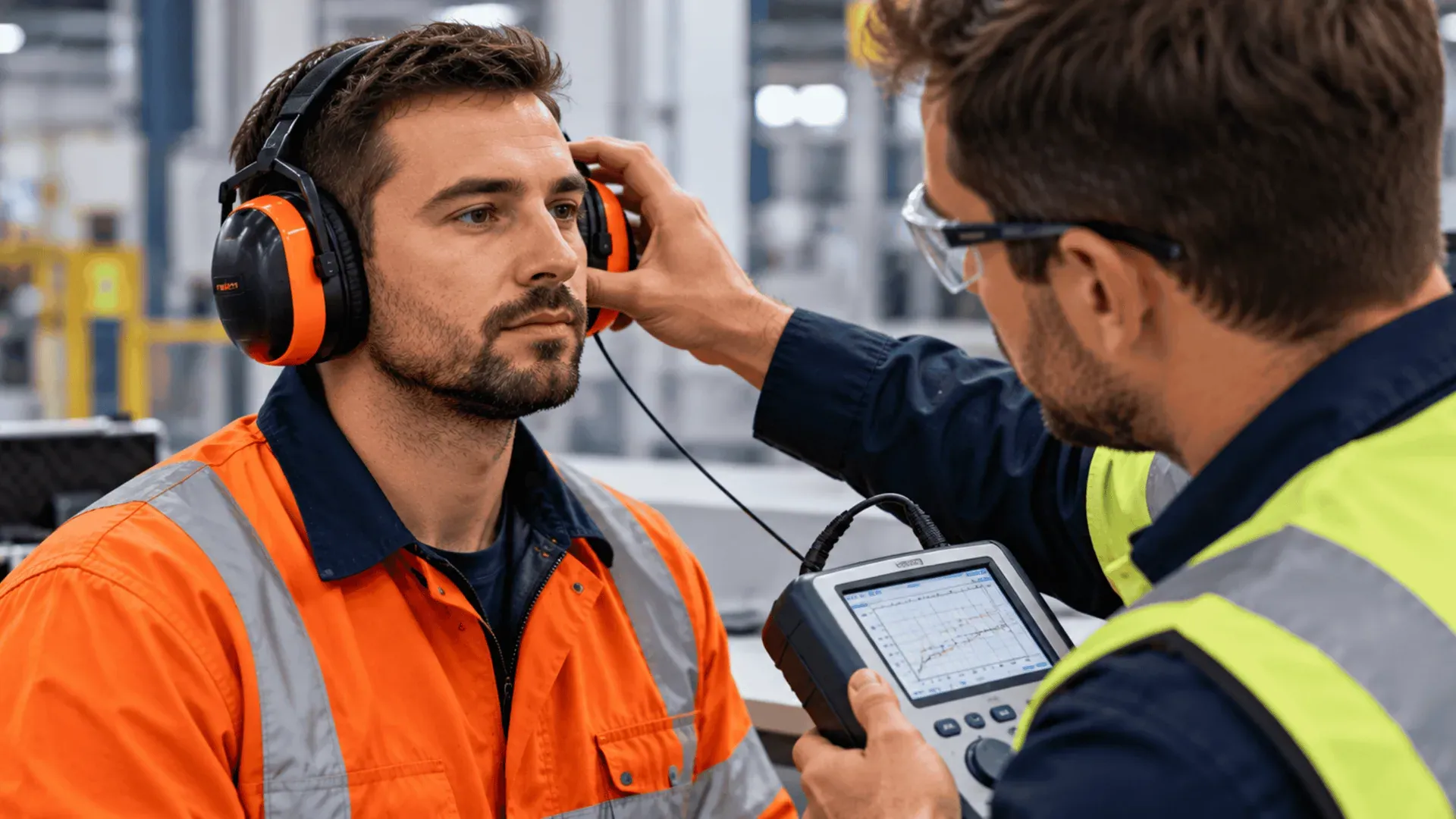
Providing hearing protection to workers is one thing. Knowing whether it actually reduces noise to safe levels for each individual is another. Generic attenuation ratings on the packaging do not tell the whole story. Real world performance depends on fit, and fit varies from person to person.
Our hearing protection fit testing service measures the actual noise reduction achieved by each worker with their assigned hearing protection. No assumptions. Real data.
We use Personal Attenuation Factor (PAF) testing technology to measure the noise reduction each worker achieves with their earplugs or earmuffs. The worker wears their hearing protection while we measure the sound level reaching their ear. The difference between the ambient noise and the protected level is their personal attenuation factor.
This tells you whether the hearing protection is providing adequate noise reduction for the specific noise levels in your workplace.
The Class or SLC rating on hearing protection packaging is based on laboratory testing under ideal conditions. In practice, workers rarely achieve that level of attenuation. Incorrect insertion of earplugs, poor fitting earmuffs, ear canal shape variations and even hair or glasses can significantly reduce effectiveness.
Studies consistently show that real world attenuation is often less than half the rated value. That means workers you believe are protected might still be exposed to damaging noise levels.
Hearing protection fit testing works best alongside workplace noise monitoring. The noise survey tells you how much noise reduction is needed. The fit test confirms whether the selected protection delivers that reduction for each worker.
Together, these services close the loop on your hearing conservation program. Workers get protection that actually works. You get documented evidence of compliance.
We can deliver hearing protection fit testing at your workplace with minimal disruption. Testing typically takes 5 to 10 minutes per worker. For sites that also need respirator fit testing, both services can run on the same visit.
Noise induced hearing loss is permanent. Workers who lose hearing due to inadequate protection at work face lifelong consequences. Difficulty hearing conversations, inability to hear warning signals, social isolation and mental health impacts. Workers compensation claims for hearing loss are among the most costly for employers over time, particularly when large numbers of workers are exposed over many years.
The financial case for proper fit testing is straightforward. The cost of testing is negligible compared to the long term liability of workers compensation claims for hearing loss. More importantly, testing prevents real harm to real people.
Businesses that have recently reviewed their hearing protection program after years of relying on rated protection values often discover that a significant proportion of their workforce was not achieving adequate attenuation. This realisation requires immediate action and often a review of exposure history for compensation liability assessment purposes.
We work with businesses to transition from rated value compliance to individual fit tested protection. The process involves selecting a small range of approved hearing protectors, conducting fit testing for all exposed workers, documenting results and establishing a process for new workers and annual re-testing. Most businesses complete this transition within a few weeks.
A Personal Attenuation Factor test measures the actual noise reduction achieved by a specific hearing protector on a specific individual in real time. The worker wears the hearing protector and microphones measure the sound level at the ear under the protector compared to the ambient sound level. The difference is the personal attenuation factor. Unlike the rated value on the packaging, the PAF reflects actual real world performance for that worker.
The rated protection value on hearing protection packaging is determined under laboratory conditions with trained participants inserting earplugs correctly or fitting earmuffs to standardised test heads. In real workplaces, workers may insert earplugs incompletely, rush the fitting, wear earmuffs with glasses frames breaking the seal, or simply use the wrong size. Research consistently shows real world attenuation is typically 50 percent or less of the rated value.
A failed test means the current hearing protector is not providing adequate noise reduction for that worker. We trial alternative options until a suitable fit is found. This might be a different size, a different brand, a different style or a different type of hearing protector entirely. If no passive hearing protection provides adequate fit, electronic noise attenuating hearing protection or changes to work practices may be needed.
No. Fit testing and noise monitoring serve different purposes and you need both. Noise monitoring tells you the noise levels workers are exposed to and whether hearing protection is needed at all. Fit testing confirms that the selected hearing protection delivers adequate attenuation for those specific noise levels. One without the other leaves gaps in your hearing conservation program.
Neither is universally better. Earplugs correctly inserted can provide higher attenuation than earmuffs. They are lighter, more comfortable for extended wear and compatible with other PPE like hard hats. Earmuffs are easier to put on correctly each time, more suitable for workers who frequently put on and take off hearing protection and easier to inspect for condition. The best choice depends on the specific noise level, the work environment and the worker. Fit testing resolves the question for each individual.