
Have a question or planning a project? Contact our team for expert guidance and reliable support.
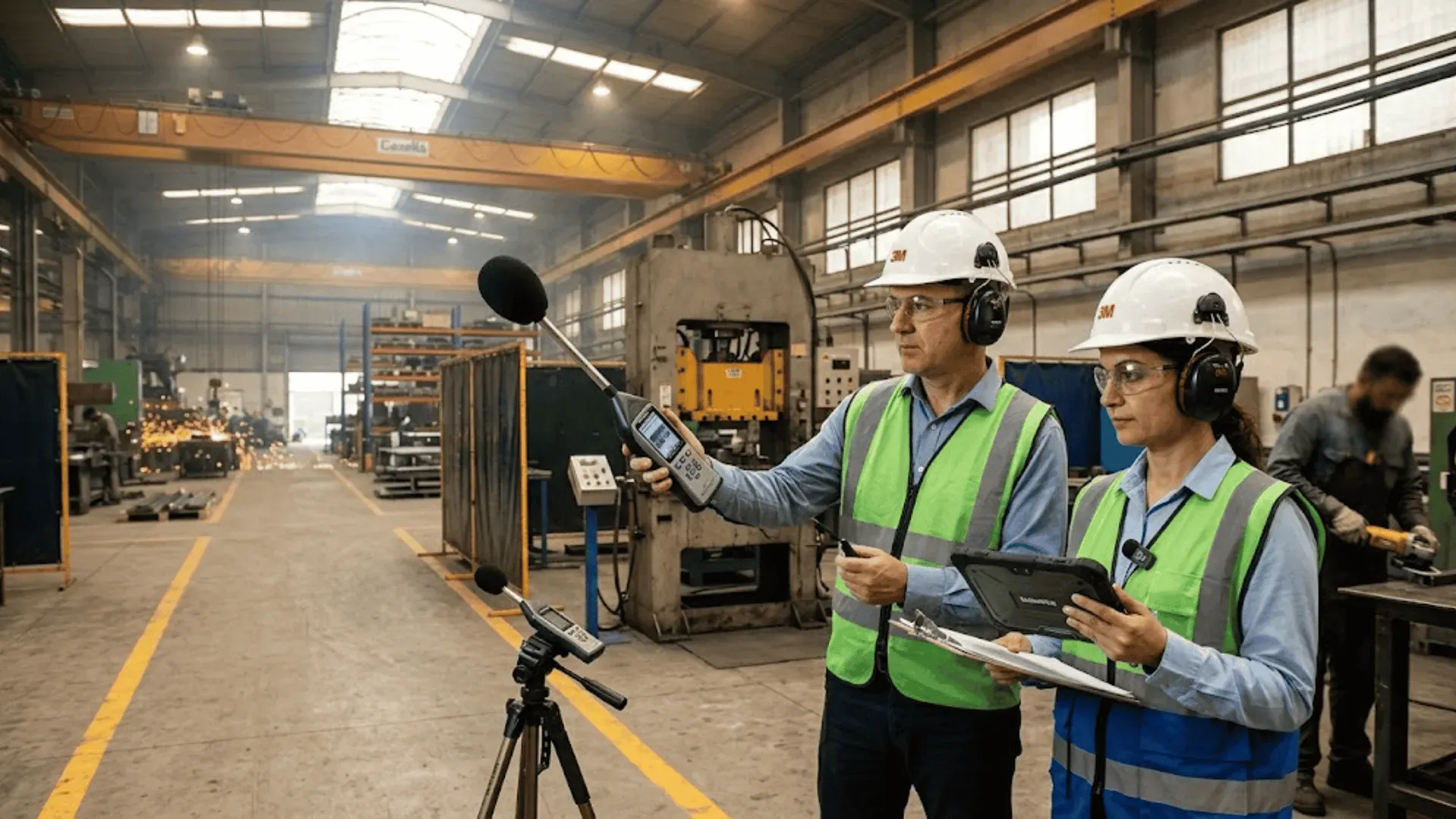
Excessive noise is one of the most common workplace hazards in Australia. Prolonged exposure above safe levels causes permanent hearing damage. Once lost, hearing does not come back. That makes noise monitoring one of the most important occupational hygiene assessments you can invest in.
We conduct noise monitoring surveys that measure both personal exposure and area noise levels. Our results tell you exactly where the risks are and whether your current controls are working.
Our occupational hygienists use calibrated noise dosimeters and sound level meters to capture accurate readings across your workplace. Personal dosimeters are worn by workers throughout their shift to measure actual exposure. Area measurements map noise levels across different zones and tasks.
All measurements comply with AS/NZS 1269 and the Safe Work Australia Workplace Exposure Standard of 85 dB(A) over an 8 hour time weighted average and a peak limit of 140 dB(C).
Our noise monitoring report identifies which tasks and areas exceed exposure standards. It shows whether engineering controls like barriers, enclosures or damping are effective. And it recommends specific actions ranked by priority.
If hearing protection is needed, we specify the right type and class for each noise source. Not all hearing protection works the same way for every frequency profile. Getting this wrong means workers think they are protected when they are not.
Our hearing protection fit testing service verifies that the selected hearing PPE actually provides the expected attenuation for each individual worker.
Construction, manufacturing, mining, fabrication, food processing and transport are all industries where noise exposure regularly exceeds safe levels. If your workers use power tools, heavy machinery, pneumatic equipment or work near engines and compressors, noise monitoring should be on your calendar.
We recommend noise surveys whenever you introduce new equipment, change processes or receive worker complaints about noise. Even if you did a survey two years ago, things change. Regular monitoring keeps you compliant and keeps your workers safe.
Noise monitoring is often conducted alongside other occupational hygiene assessments. Our dust monitoring and air quality monitoring services cover the other common exposure risks in noisy work environments.
A single noise survey gives you a snapshot in time. A noise management program gives you a systematic approach to controlling noise exposure across your entire operation and tracking improvement over time. We help businesses develop programs that include regular monitoring schedules, engineering control implementation plans, hearing conservation programs, audiometric testing referrals and training for supervisors and workers.
Audiometric testing is the health surveillance component of a hearing conservation program. It detects early signs of noise induced hearing loss before workers notice symptoms. Catching changes early allows intervention before permanent damage accumulates. We coordinate with audiometric testing providers and help you interpret results in the context of your noise monitoring data.
For businesses that have recently acquired new equipment or changed production processes, re-evaluation of noise exposure is essential. A grinding machine that replaced a slower model, a new compressor or a change in production volume can all significantly affect the noise environment. Do not assume last year's survey is still valid.
Safe Work Australia sets the workplace exposure standard for noise at an 8 hour time weighted average of 85 dB(A) and a peak sound pressure level of 140 dB(C). If workers are exposed above these levels, controls must be implemented following the hierarchy of controls. Engineering controls take priority over hearing protection.
If workers need to raise their voice to be heard at a normal speaking distance, if workers experience ringing in the ears after a shift, or if powered tools and machinery are used regularly, noise monitoring is warranted. The general rule is that if you need to shout to someone a metre away, the noise level is likely above 85 dB(A).
Yes. Under WHS regulations, PCBUs must identify and control noise hazards. If there is uncertainty about whether noise levels exceed the exposure standard, monitoring is the appropriate way to determine this. Regulators can require monitoring if they believe workers may be exposed to excessive noise.
A workplace noise survey typically takes one day on site for most businesses. Larger operations with multiple areas and varied work cycles may require multiple visits to capture different shift patterns and activities. Full shift dosimetry monitoring captures exposure across the complete work day.
The right hearing protection depends on the noise frequency profile and the required noise reduction. Class 1 earmuffs provide less attenuation than Class 5. Earplugs worn correctly often provide better real world protection than earmuffs. Our noise monitoring report will specify the class and type appropriate for each exposure scenario. Follow up with hearing protection fit testing to verify workers achieve the required attenuation.