
Have a question or planning a project? Contact our team for expert guidance and reliable support.
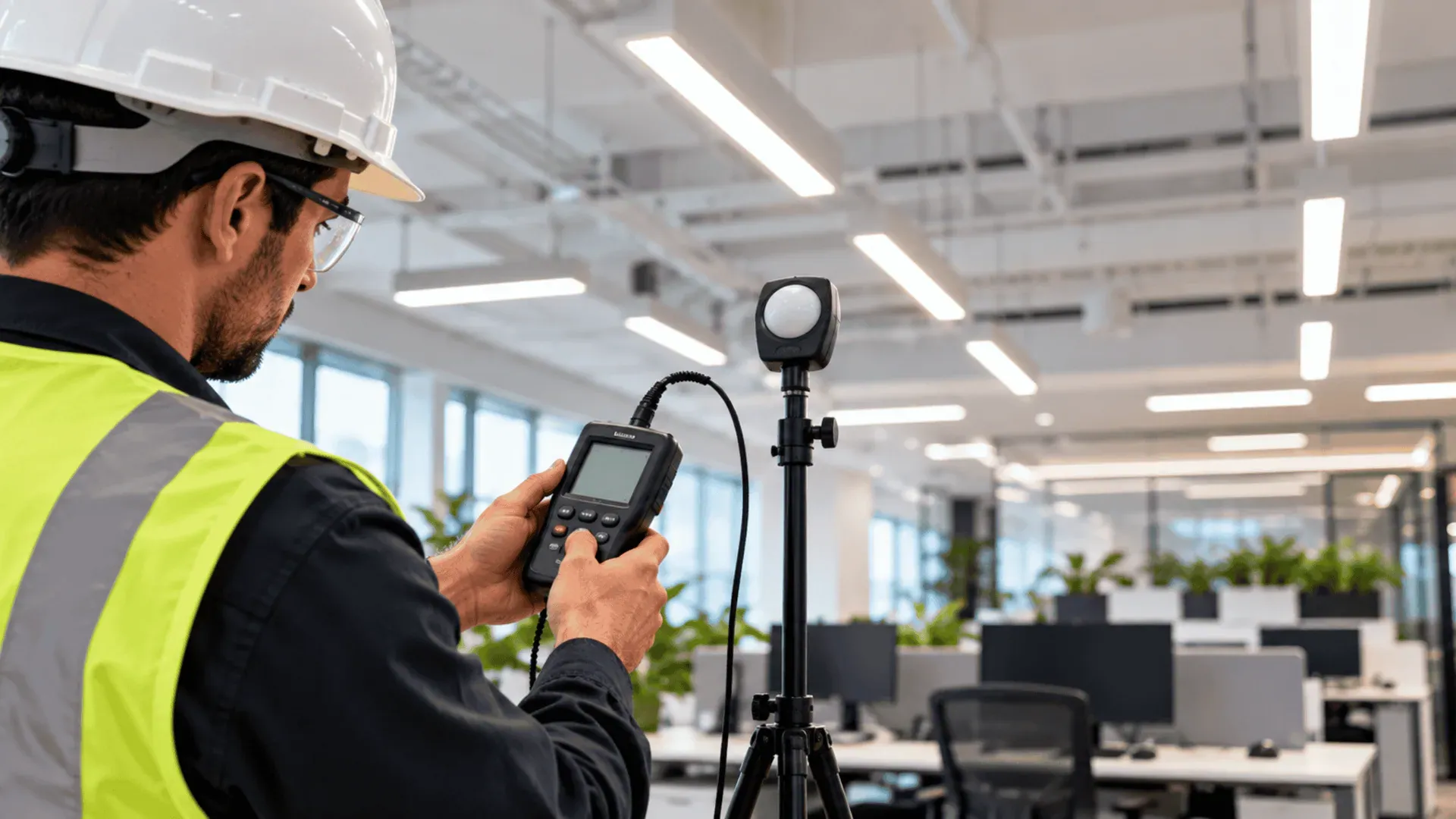
Poor lighting causes eye strain, headaches, fatigue and reduced concentration. In industrial environments, inadequate lighting contributes directly to slips, trips, falls and equipment related injuries. Getting lighting right is a basic workplace safety requirement that many businesses overlook.
Our indoor lighting assessments measure illumination levels across your workplace and compare results against the requirements of AS/NZS 1680. You get a clear picture of where lighting meets the standard and where improvements are needed.
We measure maintained illuminance (lux levels) at task surfaces and in general areas. We assess lighting uniformity to identify dark spots and areas of high contrast. Glare from luminaires, windows and reflective surfaces is evaluated for its impact on visual comfort and safety.
Measurements are taken at working height and under normal operating conditions. We assess both artificial lighting and the contribution of natural light where applicable.
Warehouses, manufacturing floors, workshops, laboratories, offices, car parks and outdoor work areas all have specific lighting requirements. The standard varies depending on the visual task being performed. Detail work like quality inspection needs significantly more light than general movement through a warehouse aisle.
Lighting assessments are particularly important after building modifications, changes in layout or when workers report visual discomfort. Ageing luminaires lose output over time, so even a workplace that met the standard at installation may fall short years later.
Our reports include specific recommendations for each area that falls below standard. This might include additional luminaires, repositioning existing fittings, changing lamp types, reducing glare sources or modifying task lighting arrangements.
We also consider energy efficiency. Modern LED solutions often provide better light quality at lower operating cost than the fluorescent or HID fittings they replace.
Lighting assessment is one component of workplace ergonomics. Our thermal stress assessments and manual handling evaluations address other ergonomic factors that affect worker comfort and safety. For a comprehensive health hazard assessment, consider our health and hygiene management plan service.
Beyond general workplace lighting, emergency lighting and exit illumination have specific requirements under the Building Code of Australia and Australian Standards AS 2293. Emergency lighting must activate automatically when normal power fails and provide sufficient light for safe evacuation. Exit signs must be continuously illuminated and visible from the required distance.
We include emergency lighting assessment as part of our broader lighting audits for commercial and industrial premises. Many businesses assume their emergency lighting is compliant because it was installed when the building was constructed. Without regular testing, they do not know that battery systems have degraded, lamps have failed or exit signs are obscured by building modifications.
Regular testing of emergency lighting systems is a legal requirement under AS 2293. Functional testing monthly, full discharge testing at 6 monthly intervals and annual certification by a competent person are the minimum requirements. We help businesses establish testing programs and document results to demonstrate compliance.
For businesses relocating to new premises or undertaking office fit outs, a lighting design review before construction begins ensures the completed space will meet AS/NZS 1680 requirements without costly rework. Specifying appropriate lighting at design stage is far cheaper than adding or repositioning luminaires after fit out is complete.
AS/NZS 1680 is the series of Australian and New Zealand standards covering interior and workplace lighting. Different parts of the standard address different work environments including general principles, office and screen based tasks, educational and training facilities, hospitals, retail premises and outdoor work areas. The standard specifies minimum maintained illuminance levels in lux, maximum glare ratings and uniformity requirements for each type of space and task.
A lux is a unit of illuminance equal to one lumen per square metre. The amount you need depends on the visual task. General circulation areas like corridors typically need 80 to 160 lux. General office work needs 320 lux. Drawing offices and fine inspection tasks need 600 to 800 lux or more. Detailed assembly and quality control work can require over 1000 lux at the task surface. AS/NZS 1680 specifies the requirement for each task type.
Glare occurs when there is excessive brightness contrast in the field of view. Disability glare reduces the ability to see detail. Discomfort glare causes eye strain and fatigue without necessarily reducing visual acuity. Sources include bare luminaires, reflections from screen surfaces, windows and high gloss work surfaces. Glare is assessed using the Unified Glare Rating (UGR) system. Addressing glare sources often has a bigger impact on worker comfort than simply increasing light levels.
Yes. Inadequate lighting is a contributing factor in slips, trips and falls, material handling errors and equipment related injuries. Workers cannot avoid hazards they cannot see clearly. In manufacturing and construction environments, poor lighting significantly increases the risk of errors and injuries. Adequate lighting is a basic workplace safety requirement, not just a comfort issue.
Natural light contribution varies significantly throughout the day and with weather conditions. Our assessments consider both the contribution of natural light and the performance of the artificial lighting system independently. This ensures the workplace meets lighting standards on overcast days and at night when natural light contribution is minimal or absent.