
Have a question or planning a project? Contact our team for expert guidance and reliable support.
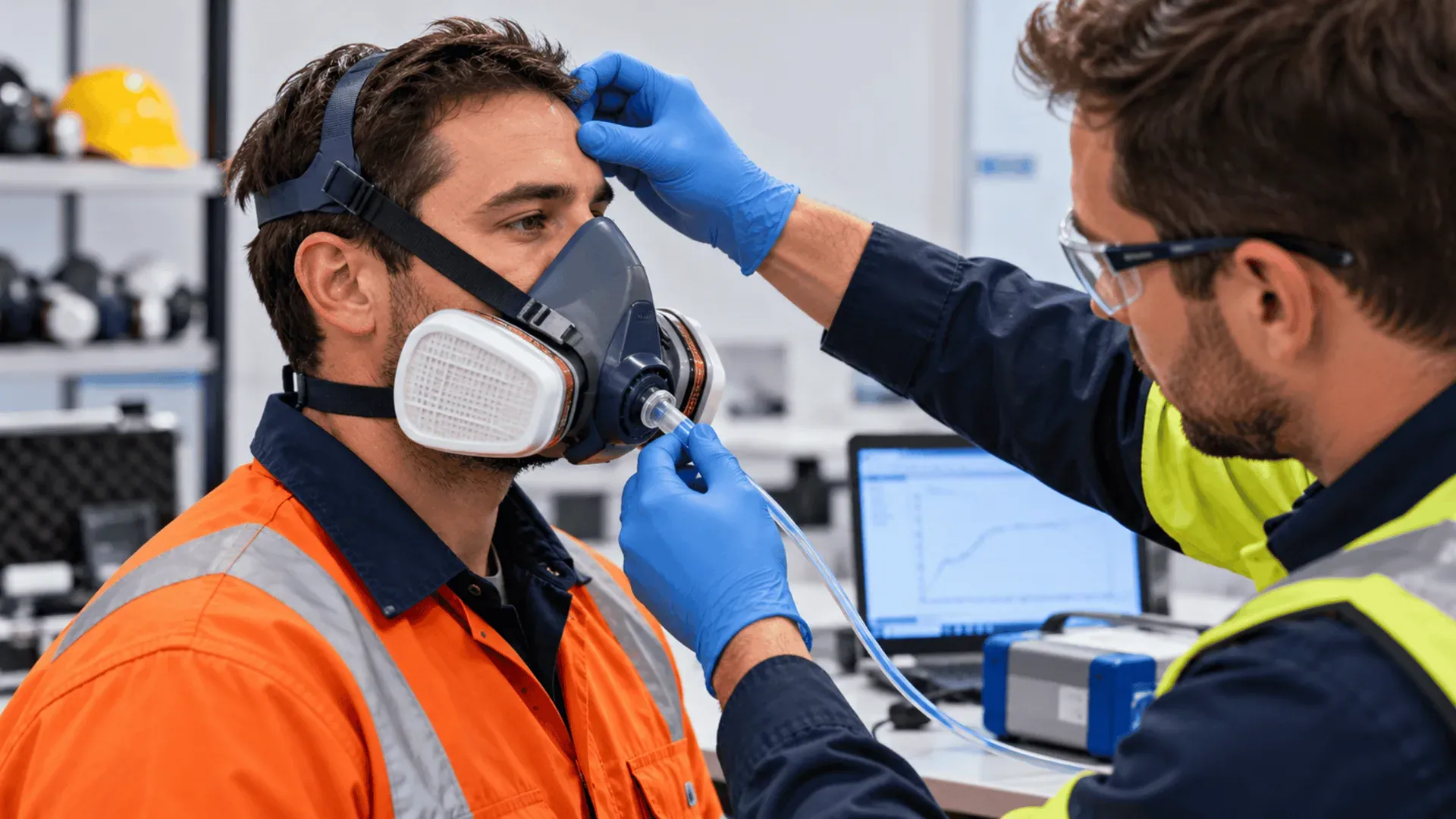
A respirator that does not seal properly to the face is not protecting the worker wearing it. Facial hair, facial shape, weight changes and even dental work can affect the seal. Without fit testing, you are guessing. And guessing with respiratory protection can have serious consequences.
Our respirator fit testing service ensures that every worker assigned respiratory protection has been individually tested and confirmed to achieve an adequate seal with their assigned respirator.
We offer both quantitative and qualitative fit testing methods. Quantitative testing uses a particle counter to measure the actual seal between the respirator and the face. It gives a numerical fit factor that removes all guesswork. Qualitative testing uses taste or odour sensitivity to detect leakage and is suitable for half face respirators.
Both methods comply with AS/NZS 1715 requirements for respiratory protective equipment selection, use and maintenance.
Fit testing should be conducted when a worker is first assigned a respirator, when they change to a different brand or model, and at regular intervals after that. We recommend annual testing as a minimum. Testing should also be repeated after significant weight changes, dental work or facial surgery.
If your workers are exposed to hazardous dusts like respirable crystalline silica or welding fumes, proper fit testing is not just good practice. It is essential for their health.
Every tested worker receives a documented fit test result confirming the specific make and model of respirator that fits them. Workers who fail the test are trialled with alternative respirator options until a suitable fit is found.
We also provide training on correct donning, doffing, user seal checks and basic maintenance. A fit tested respirator only works if the worker knows how to put it on properly every time.
For workplaces where noise is also a concern, our hearing protection fit testing ensures ear protection is equally effective. Both services can be delivered on the same site visit to minimise disruption.
Fit testing is one component of a respiratory protection program. The program also covers respirator selection, care and maintenance, storage, medical fitness assessment and worker training. A complete program ensures that respiratory protection actually works every time it is needed.
Respirator selection starts with understanding the hazard. The type of contaminant, its concentration relative to the occupational exposure standard and the duration of exposure all determine what class and type of respirator is appropriate. Selecting the wrong respirator, even if it fits perfectly, does not protect the worker.
Medical fitness for respirator use is another consideration. Wearing a respirator increases breathing resistance and work of breathing. Workers with certain cardiovascular or respiratory conditions may not be medically fit to wear tight fitting respirators. We advise on medical fitness assessment requirements as part of setting up your respiratory protection program.
Training covers correct donning and doffing, user seal checks before each use, storage to prevent contamination and damage, and recognising when a cartridge or filter needs replacing. These skills need regular reinforcement. A worker trained once two years ago may have forgotten critical steps.
Qualitative fit testing uses the wearer's sense of taste or smell to detect leakage. Saccharin or bitrex solutions are nebulised into a hood around the worker's head. If they can taste or smell the test agent with the respirator on, the fit is inadequate. Quantitative fit testing uses an instrument to count particles inside and outside the respirator to calculate an actual fit factor. Quantitative testing is more objective and required for higher risk situations.
Annual fit testing is the standard recommendation under AS/NZS 1715. Testing should also be repeated whenever the worker changes to a different make or model of respirator, after significant facial changes like substantial weight loss, dental surgery or facial injury, and when a worker reports that the respirator no longer feels right or is less comfortable than before.
Facial hair in the sealing area of a half face or full face respirator prevents an adequate seal. Workers with beards who require tight fitting respiratory protection need to be clean shaven at the seal line when wearing a respirator, or should use a powered air purifying respirator (PAPR) or supplied air respirator that does not rely on a face seal. Fit testing a worker with a beard is not valid.
P2 disposable respirators provide the same filter efficiency class as reusable P2 half face respirators when properly fitted. They still require fit testing. For high risk exposures like silica or asbestos, the filter class may need to be P3 rather than P2. The appropriateness depends on the measured or estimated exposure level relative to the exposure standard.
No. Respirators should not be shared between workers. Sharing creates hygiene issues and, more importantly, a respirator fitted to one worker may not provide adequate seal for another. Each worker should have their own assigned respirator that has been individually fit tested. This is especially important for reusable half face and full face respirators.